Production-tested differences in Dk, loss tangent, processing burden and total cost of ownership between F4B and RO4350B — plus a selection framework that resolves the choice by design priority.
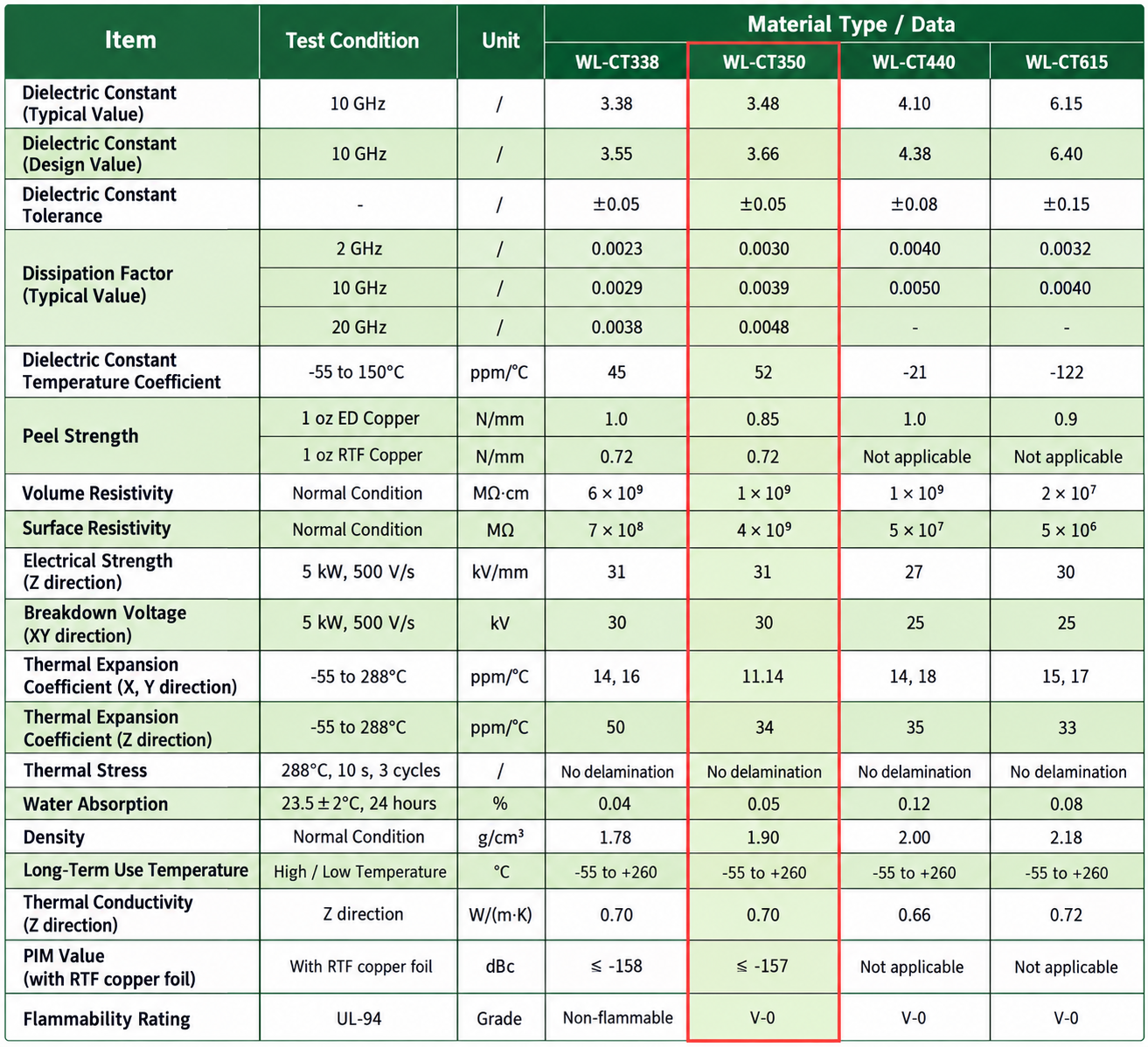
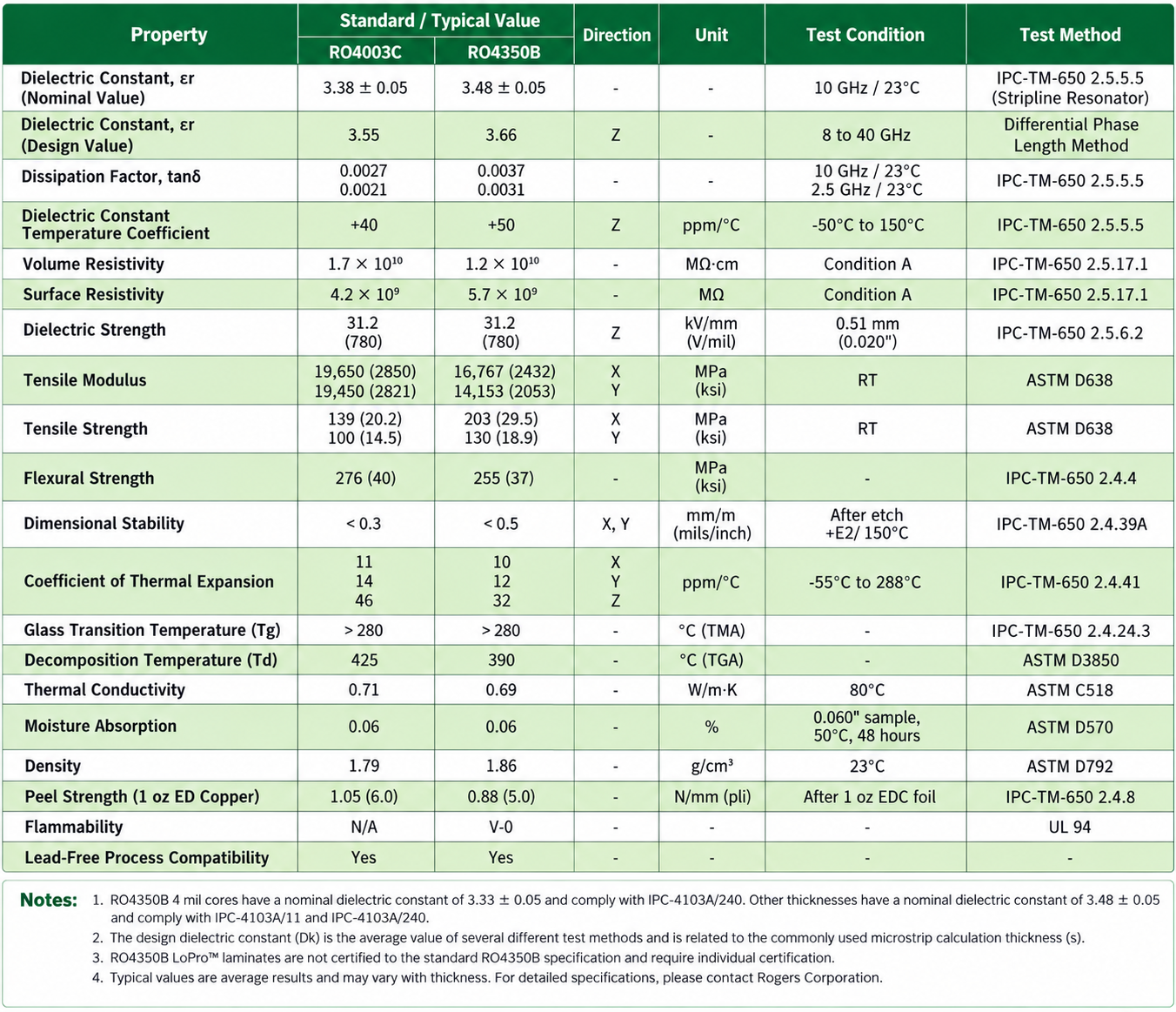
F4B WL-CT350 and RO4350B are the two workhorses of the domestic and imported high-frequency laminate worlds, and choosing between them shapes cost, schedule and performance for the whole program. This comparison draws on production test data — the F4B side is introduced in our PTFE glass-fiber F4B laminate guide and the RO4350B side in the RO4350B material deep-dive.
Three property families separate the two materials:
| Attribute | F4B WL-CT350 | RO4350B |
|---|---|---|
| Dielectric constant | 3.48 ±0.05 | 3.48 ±0.05 |
| Loss tangent @ 10 GHz | 0.0012 | 0.0039 |
| Thermal conductivity | 0.45 W/m·K | 0.69 W/m·K |
| Phase stability | –55°C to +260°C (superior) | Narrower window |
| Raw material cost | Baseline | ~+220% |
| Processing surcharge | +15–20% (plasma, special drilling) | +5–8% |
The manufacturing gap is where budgets quietly leak, so it deserves the same scrutiny as the datasheet:
The cleaner way to decide is by design priority:
Total cost of ownership flips the sticker-price story: RO4350B carries 220% higher material cost but processes 5–8% cheaper, while F4B delivers 30–50% longer service life that reduces ten-year cost by 25–40%. Meanwhile the supplier frontier is moving on both sides — hybrid F4B/RO4350B stack-ups (about 30% cost-optimized), nano-modified F4B reaching 0.8 W/m·K, laser direct structuring, 3D-printed high-frequency circuits, and 110 GHz validation labs backed by AI-driven material-selection systems.
Reduce the decision to three questions and the answer usually falls out: frequency above 30 GHz points to F4B; thermal management as the priority points to RO4350B; a constrained budget points to F4B. On supplier qualification, F4B specialists must own PTFE-dedicated equipment, plasma systems and ±3% impedance control, while RO4350B experts need Rogers OEM certification, 16+ layer experience and thermal design capability. Programs operating across both material families can mirror the combined-stack approach in our RO3003 and FR-4 hybrid construction guide.
Frequently Asked Questions
When frequency exceeds roughly 30 GHz, when the loss budget is extreme, or when wide-temperature phase stability matters most. F4B's 0.0012 loss tangent and –50°C to +150°C stability win those three cases despite heavier processing.
PTFE-dedicated drill tooling (130° point, 18–22 krpm), plasma desmear or sodium naphthalene activation, and a low-temperature slow-press lamination cycle — adding a 15–20% processing surcharge over RO4350B's near-FR-4 handling.
F4B in long-service applications: 30–50% longer lifespan cuts ten-year cost by 25–40%. RO4350B wins where yield on complex multilayers (5–8% higher) and faster prototyping dominate the economics.
Yes. Hybrid builds use the PTFE layer where loss is critical and RO4350B or FR-4 elsewhere, with bonding films and surface activation at the interface — suppliers report around 30% cost optimization on such constructions.
Send your frequency band, layer count and cost targets and we will run both materials against your stack-up with lead times included.
Get a Fast Quote Fast Reply on WhatsApp