PCB Materials and Surface Finishes play a critical role in determining the electrical performance, reliability, manufacturing cost, and long-term stability of printed circuit boards. Choosing between FR4, Rogers, and PTFE-based laminates requires an understanding of dielectric constant (Dk), dissipation factor (Df), thermal properties, and processing requirements.
This PCB Materials and Surface Finishes guide compares common substrate materials and surface finishing options, including ENIG, OSP, immersion silver, immersion tin, and HASL, to help engineers select suitable solutions for RF, microwave, high-speed, and industrial PCB applications.
For PCB Materials and Surface Finishes selection, FR4 is a glass-reinforced flame-retardant laminate family widely used for conventional multilayer printed circuit boards. It generally offers good availability, established fabrication processes and cost effectiveness. However, FR4 is not one fixed material: dielectric properties, glass transition temperature and high-frequency losses vary by exact grade. For high-speed or RF work, obtain grade-specific electrical data at relevant frequencies.
High-Tg FR4 typically offers greater thermal processing margin. Some grades have glass transition temperatures around 170°C or above, but Tg is not the same as a PCB’s maximum continuous service temperature. Thermal reliability also depends on material decomposition, expansion, assembly conditions and product duty cycle.
Halogen-free FR4 is developed to comply with specific halogen-content requirements. That designation alone does not guarantee lower dielectric loss or better thermal characteristics. Review each laminate’s published performance and applicable environmental specification.
Rogers RO4003C and RO4350B are low-loss ceramic-filled hydrocarbon laminates used in antennas, RF front ends, radar and microwave designs. Their processing is generally more compatible with conventional PCB fabrication than many PTFE-based materials. Published process dielectric constants are approximately 3.38 for RO4003C and 3.48 for RO4350B under specified testing conditions; use the manufacturer’s recommended design values for transmission-line calculations.
See the official Rogers RO4000 information for current material documentation.
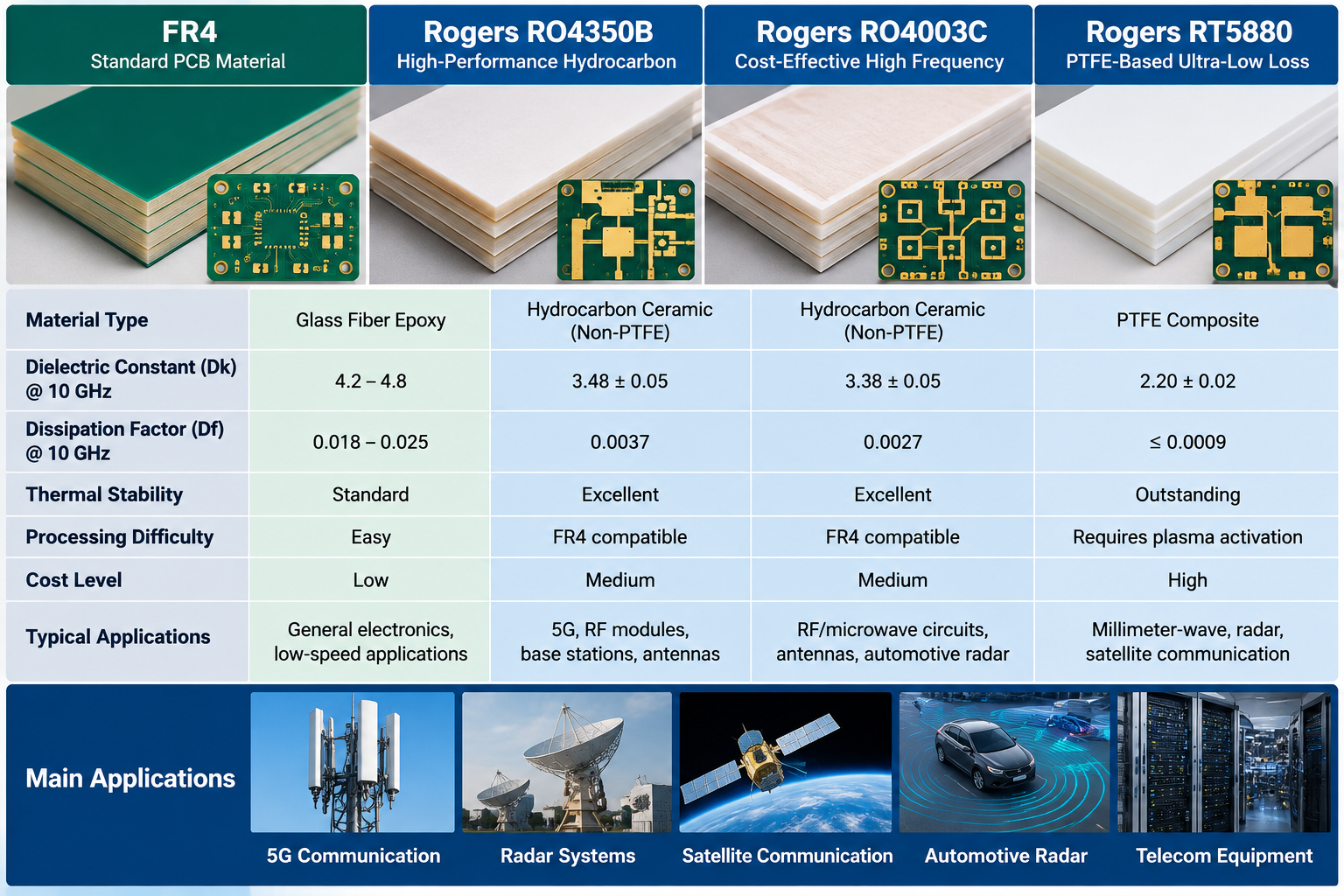
In PCB Materials and Surface Finishes selection, certain PTFE-based laminates provide low dielectric loss for demanding microwave applications. Product formulations differ: PTFE materials may be glass-reinforced, ceramic-filled or otherwise modified. Examples include specific Rogers RT/duroid and RO3000 grades and materials supplied by Taconic and Wangling. Exact laminate selection determines drilling, activation, bonding and multilayer lamination conditions. A PTFE-family label alone is not sufficient for process planning.
| aterial family | Main characteristics | Typical applications |
|---|---|---|
| Standard FR4 | Cost-effective, widely available | General electronic circuits |
| High-Tg FR4 | Greater thermal processing margin | Industrial and multilayer PCBs |
| Halogen-free FR4 | Specific halogen-content compliance | Environmentally specified products |
| Rogers RO4000 | Low-loss hydrocarbon ceramic materials | RF, antenna and microwave circuits |
| PTFE-based RF laminates | Selected grades offer very low dielectric loss | RF filters, radar and microwave systems |
No single material is ideal for every PCB. For fabrication limits and material options, review our PCB manufacturing capabilities. For conductor loss and assembly trade-offs, see our ENIG vs immersion silver vs immersion tin comparison. Need a quotation for an RF or microwave PCB? Contact our PCB manufacturing team with your Gerber files, stackup, preferred laminate, quantity and required surface finish for a manufacturability review and quote.
When comparing PCB Materials and Surface Finishes, the selection should be based on frequency, insertion loss, Dk stability, thermal performance, layer count, manufacturing cost, and availability.
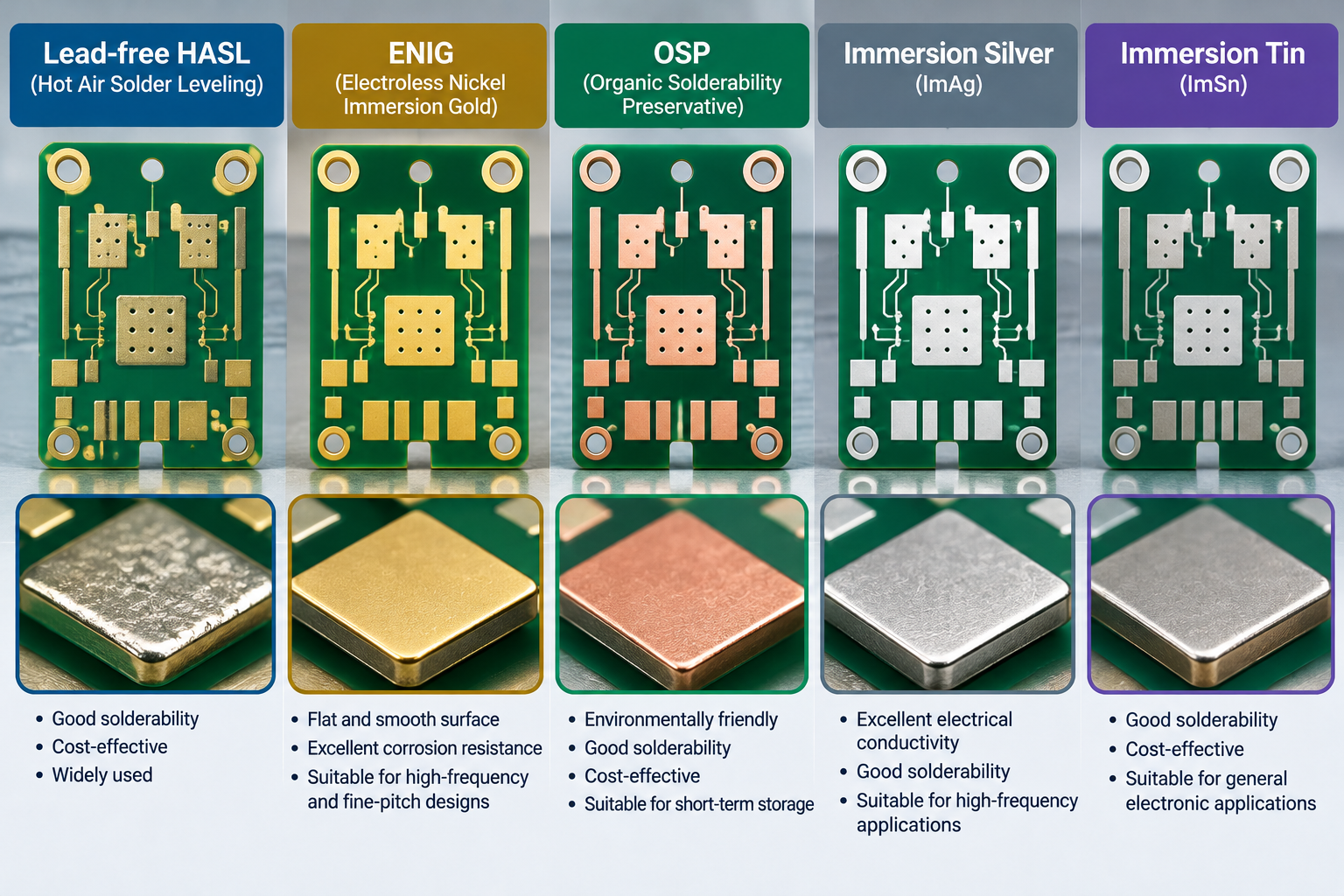
Hot Air Solder Leveling, or HASL, applies solder to exposed copper surfaces and uses hot air to remove excess solder.
Traditional leaded HASL and lead-free HASL use different solder alloys and processing conditions.
HASL can provide good solderability at a relatively economical cost.
However, its surface is generally less planar than finishes such as ENIG or immersion tin.
This makes HASL less desirable for certain fine-pitch components, tight coplanarity requirements, and sensitive surface-mount assemblies.
For RF applications, solder thickness variation over exposed transmission-line structures should also be considered.
Among PCB Materials and Surface Finishes, ENIG is a widely used finish that deposits electroless nickel followed by a thin immersion gold layer.
It provides a flat surface, good solderability, and useful oxidation protection when manufactured and stored correctly.
ENIG is frequently selected for fine-pitch assembly and complex PCBs.
Nevertheless, ENIG requires careful process control and compliance with the applicable finish specification.
For high-frequency designs, nickel beneath the gold may contribute to conductor loss in certain exposed RF geometries.
Therefore, ENIG should be selected according to both assembly requirements and RF electrical performance.
OSP uses a thin organic protective layer over exposed copper.
It offers a relatively flat surface without introducing a thick metallic finish layer.
When comparing PCB Materials and Surface Finishes, OSP can be attractive for cost-sensitive products and particular RF designs where exposed conductor surface characteristics matter.
Its limitations include handling sensitivity, storage considerations, and restrictions related to repeated thermal assembly cycles.
The actual suitability of OSP depends on the chemistry and the assembly process.
Immersion silver provides a thin metallic coating over exposed copper.
It offers good surface planarity and is used in some high-speed and high-frequency PCB applications.
However, silver surfaces must be protected against contamination and tarnishing during storage and handling.
Packaging, environmental conditions, and manufacturing process controls can influence the finish’s long-term performance.
Immersion tin is a planar metallic surface finish that can be used for fine-pitch assembly.
Compared with HASL, it provides a more uniform soldering surface.
One consideration is the growth of copper-tin intermetallic compounds over time, which may affect available solderable tin and storage performance.
For this reason, shelf-life requirements, packaging, and assembly conditions should be reviewed carefully.
| Finish | Primary advantages | Important considerations |
|---|---|---|
| Lead-free HASL | Economical, good solderability | Surface flatness |
| ENIG | Flat surface, oxidation protection | Cost, process control, RF nickel loss |
| OSP | Thin coating, relatively low cost | Handling and assembly limits |
| Immersion silver | Flat metallic surface | Tarnish and contamination |
| Immersion tin | Good planarity | Storage and intermetallic growth |
For microwave and high-frequency PCBs, substrate and finish selection should be evaluated together.
The designer should consider:
Operating frequency and insertion-loss budget.
Material dielectric constant and dissipation factor.
Copper foil profile and transmission-line geometry.
Surface finish conductivity and metal layer structure.
Assembly requirements and expected storage conditions.
Lamination, drilling, and plating compatibility.
Manufacturing feasibility and total production cost.
For example, Rogers RO4350B combined with a suitable finish can be an effective choice for some RF designs, while lower-loss PTFE-based materials may be preferable for other microwave structures.
The best combination depends on the complete electrical and manufacturing specification.
At HF PCB Pro, customers can request a manufacturing review for Rogers, PTFE, FR4, and hybrid stackup projects before confirming their material and finish selection.
FR4 is commonly used for general-purpose PCB production. Selected Rogers materials provide more controlled dielectric characteristics and lower losses for RF and microwave circuits.
No. High-Tg FR4 can provide advantages for certain thermal and assembly requirements, but it may not offer the best cost or electrical performance for every application.
There is no universal best finish. The correct choice depends on frequency, transmission-line geometry, electrical losses, soldering requirements, and environmental conditions.
Yes, ENIG can be used on many Rogers PCB designs. However, its nickel layer should be evaluated where microwave conductor loss is critical.
Yes. Hybrid multilayer PCB constructions are possible, provided that compatible bonding materials, lamination cycles, mechanical properties, and drilling processes are considered.
Send us your stack-up and material combination. Our engineering team will review the lamination plan, drilling and plating strategy, then quote your hybrid RF board.
Get An Engineering Review → Fast Reply on WhatsApp