How Dk and Df behave from 1 MHz to 10 GHz — and why high-speed laminates stay flat where FR-4 drifts.
When selecting substrate materials for high-frequency circuits, pay special attention to the dielectric constant (DK) and — just as importantly — how it varies with frequency. For applications that emphasize high-speed signal transmission or controlled characteristic impedance, the dielectric loss (DF) and its behavior across frequency, temperature, and humidity deserve the closest scrutiny.
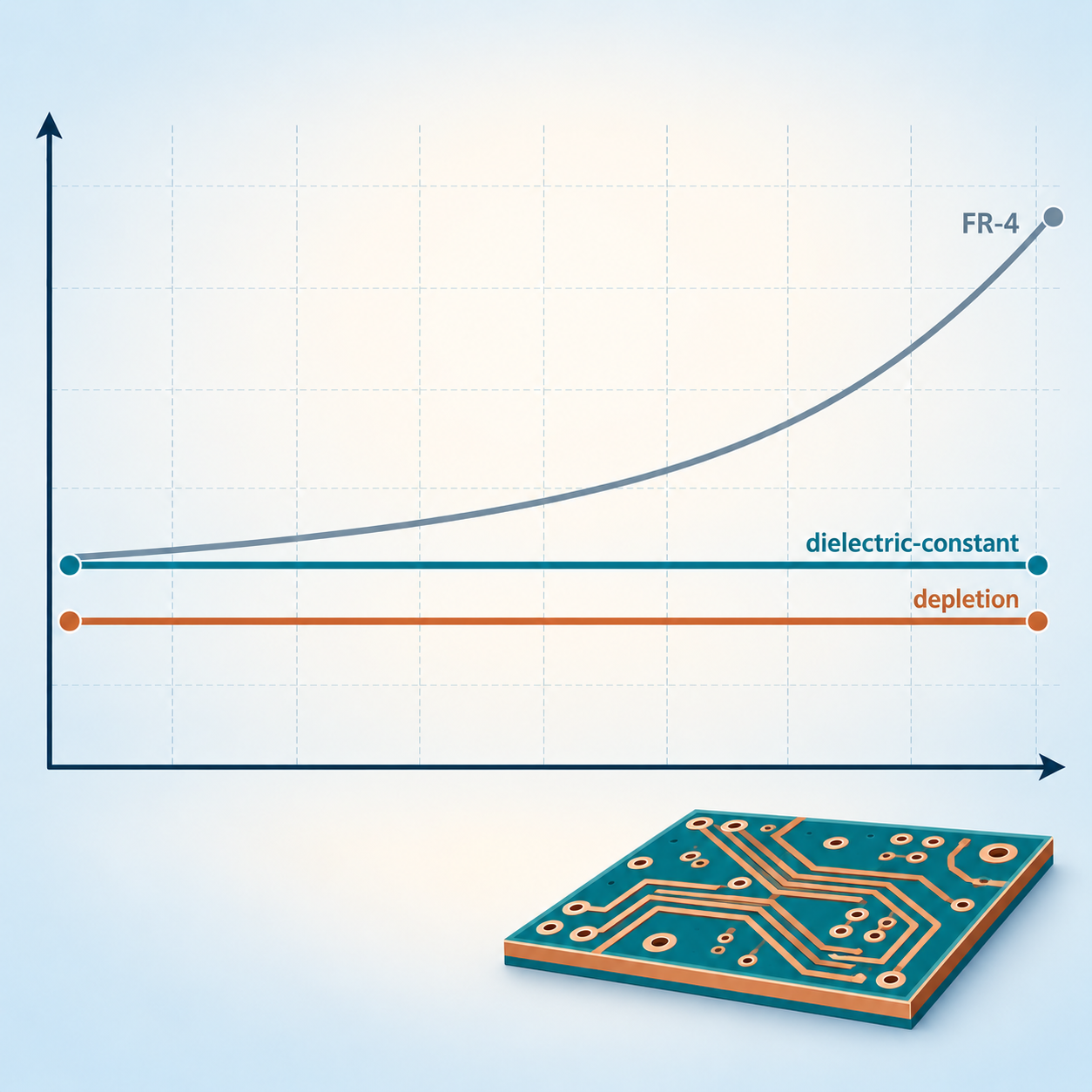
Standard substrates show significant DK variation as frequency changes, especially in the 1 MHz to 1 GHz range. A standard epoxy-glass laminate (FR-4) measures DK 4.7 at 1 MHz but 4.19 at 1 GHz — a drift of more than 10%. Above 1 GHz the curve flattens somewhat: FR-4 reads about 4.15 at 10 GHz.
Materials engineered for high-speed and high-frequency performance behave very differently: within 1 MHz to 1 GHz, DK typically varies by no more than about 0.02, with only a slight downward trend across the band.
Standard substrates show significant DK variation as frequency changes, especially in the 1 MHz to 1 GHz range. A standard epoxy-glass laminate (FR-4) measures DK 4.7 at 1 MHz but 4.19 at 1 GHz — a drift of more than 10%. Above 1 GHz the curve flattens somewhat: FR-4 reads about 4.15 at 10 GHz.
Materials engineered for high-speed and high-frequency performance behave very differently: within 1 MHz to 1 GHz, DK typically varies by no more than about 0.02, with only a slight downward trend across the band.
For general-purpose substrates, DF is affected by frequency even more strongly than DK — and the trend is upward in the high-frequency range. So when judging a material’s high-frequency character, look first at how its DF behaves.
High-speed, high-frequency materials fall into two distinct camps: one holds DF nearly constant across frequency; the other varies with frequency much like general-purpose materials but starts from a much lower inherent DF. Either way, the FR-4 vs Rogers comparison shows how these differences translate into real cost and performance trade-offs.
Quick answers on Dk/Df behavior and material choice
Standard FR-4 measures about Dk 4.7 at 1 MHz and 4.19 at 1 GHz — a shift of more than 10%. High-speed laminates typically vary by no more than about 0.02 over the same range.
Both matter, but Df deserves the most attention. General-purpose substrates show a stronger upward drift in dielectric loss with frequency than in dielectric constant, and loss directly determines signal quality at high frequencies.
No — they fall into two categories. One holds Df nearly constant across frequency; the other varies similarly to general-purpose materials but from a much lower starting Df. Both can work; the difference shows up in wideband designs.
The trend flattens. FR-4, for example, moves only from 4.19 at 1 GHz to about 4.15 at 10 GHz. The steepest variation happens between 1 MHz and 1 GHz.
Tell us your frequency range and loss budget — we will match the right substrate and send a quote quickly.
Get Material Advice Fast Reply on WhatsApp