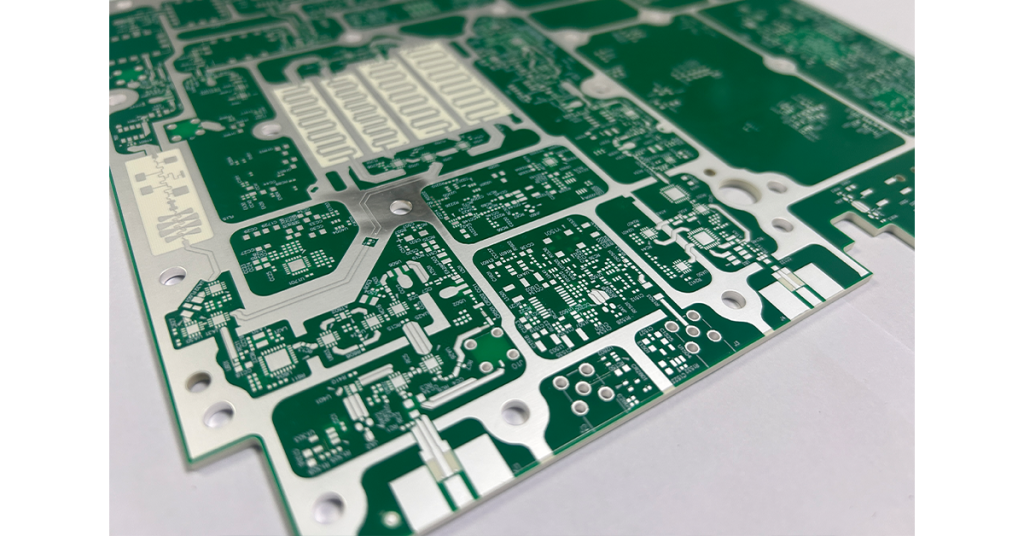
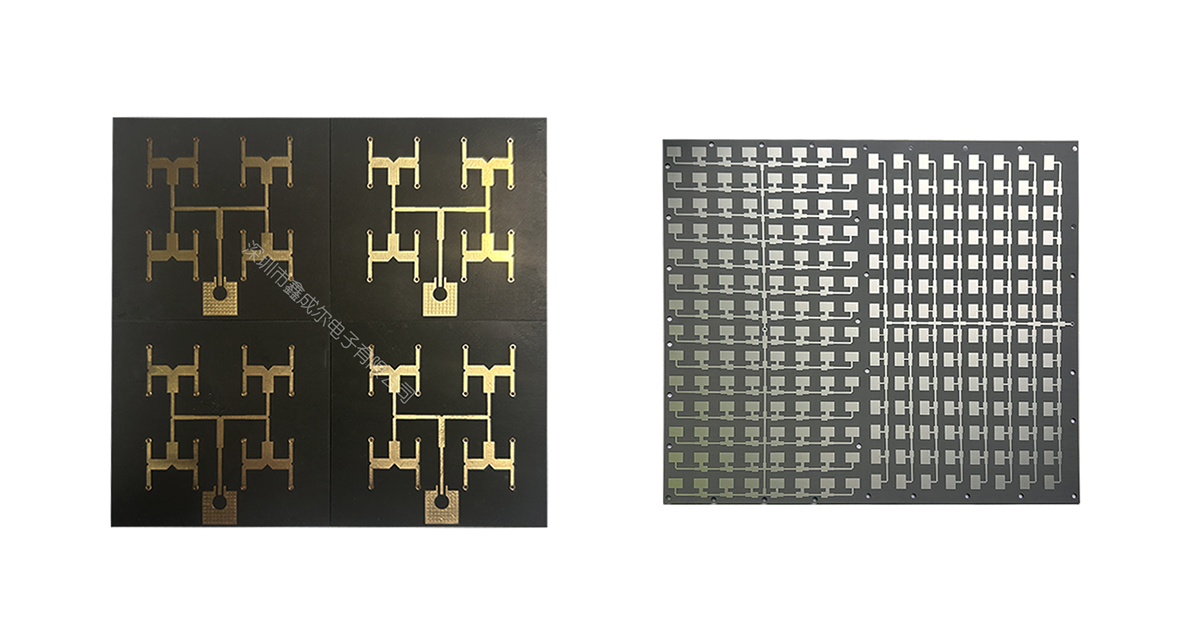
Comparison of Dielectric Loss Factor (Df)
FR-4: At 10 GHz, the dielectric loss factor (Df) of standard FR-4 is approximately 0.018–0.035, while that of low-loss FR-4 specifically designed for high frequencies can be reduced to 0.008–0.010.
F4B: At 10 GHz, the Df of F4B is as low as 0.0013–0.0017 (e.g., 0.0013 for F4BM265 and 0.0017 for F4B300); at 20 GHz, it ranges from 0.0019 to 0.0025.
Conclusion: F4B has a dielectric loss factor one order of magnitude lower than FR-4, resulting in significantly less energy attenuation at high frequencies.
High-Frequency Signal Attenuation Comparison
FR-4: At 10 GHz, signal attenuation can reach 3.2 dB/m (e.g., standard FR-4), while high-frequency-specific low-loss FR-4 can be optimized to 0.8 dB/m (e.g., RO4835HT).
F4B: At 10 GHz, the dielectric loss coefficient is only 0.0023 dB/cm (i.e., 0.23 dB/m), far lower than that of FR-4.
Conclusion: F4B exhibits over 90% lower signal attenuation than FR-4, making it suitable for long-distance high-frequency transmission.
Frequency Dependency Comparison
FR-4: Df increases significantly with rising frequency (e.g., 0.015–0.035 at 1 GHz, rising to 0.018–0.035 at 10 GHz), resulting in superlinear growth of total loss (approximately exponential growth).
F4B: Df varies very little with frequency (e.g., 0.0013 at 10 GHz and 0.0019 at 20 GHz), resulting in a gradual increase in loss.
Conclusion: F4B exhibits far superior loss stability at high frequencies compared to FR-4, making it suitable for ultra-high-frequency (e.g., millimeter-wave) applications.
Conductor Loss Synergy
FR-4: The skin effect is significant at high frequencies, and conductor loss increases with the square root of frequency; when combined with high dielectric loss, total loss increases dramatically (e.g., in the 77 GHz automotive radar band, FR-4 exhibits over 10 dB of loss per meter).
F4B: The conductor loss coefficient (0.0357 dB/cm @ 10 GHz) is lower than that of FR-4 (0.0499 dB/cm @ 10 GHz), and the low dielectric loss further reduces total loss.
Conclusion: With the synergistic optimization of conductor and dielectric losses, F4B exhibits lower total loss at high frequencies.
Differences in Application Scenarios
FR-4: Suitable for low-frequency applications below 1 GHz (e.g., consumer electronics, power boards). High-frequency-specific low-loss FR-4 can support 1–8 GHz (e.g., 10 Gbps digital signals), but performance drops sharply above 8 GHz.
F4B: Designed specifically for high-frequency applications, supporting the 1 GHz to 40 GHz range and beyond (e.g., 5G communications, millimeter-wave radar, satellite communications), with excellent performance at frequencies such as 24 GHz, 28 GHz, and 39 GHz.
Conclusion: F4B is the material of choice for high-frequency applications, while FR-4 is suitable only for low-frequency or cost-sensitive mid-frequency applications.