
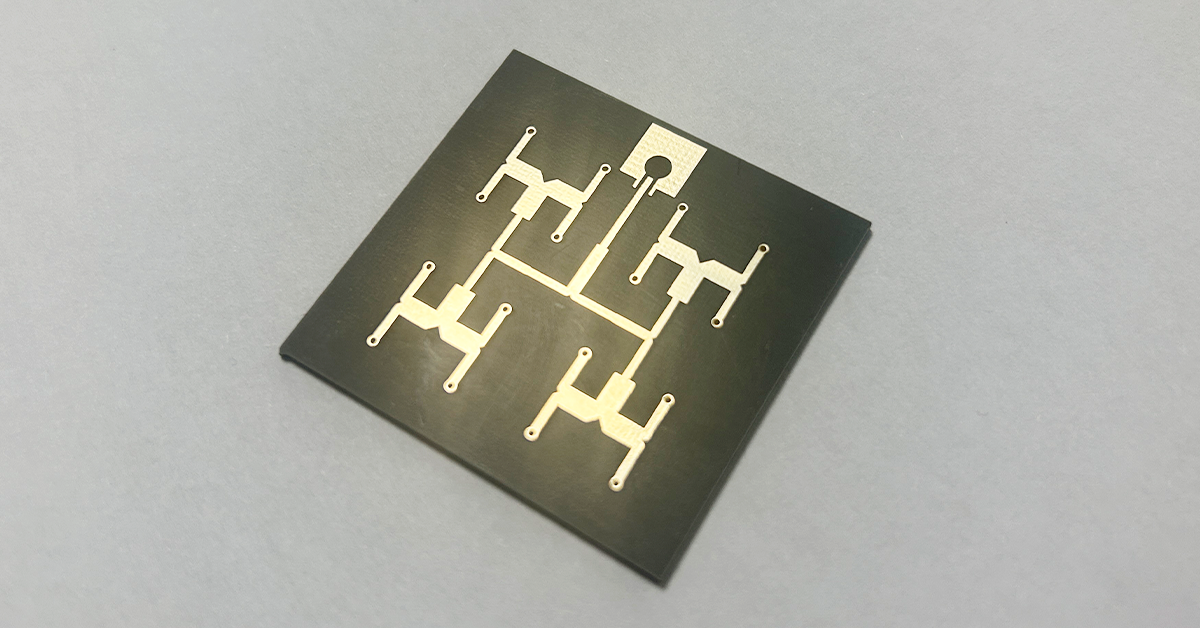
The selection of F4B as a high-frequency PCB laminating material is primarily based on its low dielectric constant, low dielectric loss, excellent temperature stability, good mechanical properties, and chemical stability. These characteristics enable it to meet the stringent requirements of high-frequency signal transmission, ensuring signal integrity and circuit reliability.
The following is a detailed analysis:
- Low Dielectric Constant (Dk) and Low Dielectric Loss Factor (Df)
High-Frequency Signal Transmission Requirements: In high-frequency (above GHz) applications, signal transmission speeds are extremely fast, making the dielectric properties of materials highly sensitive. The dielectric constant (Dk) affects signal propagation speed, while the dielectric loss factor (Df) determines signal energy loss.
Advantages of F4B:
Low Dk: The dielectric constant of F4B is typically between 2.2 and 4.0, and it varies little with frequency, reducing signal delay and phase distortion, ensuring synchronous transmission of high-speed signals.
- Low Df: Its dielectric loss factor can be as low as 0.0009~0.002, significantly lower than that of traditional FR-4 material (Df approximately 0.02), greatly reducing signal attenuation and improving transmission efficiency.
Comparison with traditional materials: Ordinary FR-4 has a high Df at high frequencies, leading to severe signal attenuation and distortion, failing to meet the requirements of high-frequency applications.
- Excellent Temperature Stability
High-Frequency Application Environment: High-frequency circuits (such as 5G communication and radar systems) typically operate in high-temperature or extreme temperature environments, requiring stable material performance.
Advantages of F4B:
Low Coefficient of Thermal Expansion (CTE): F4B’s CTE is close to that of copper foil, reducing interlayer stress caused by temperature changes, avoiding warping or delamination, and improving circuit reliability.
Stable Dielectric Properties: Its Dk and Df change very little with temperature, ensuring consistent signal transmission and suitable for a wide temperature range (e.g., -55℃ to +125℃).
- Excellent Mechanical Properties and Chemical Stability
Mechanical Properties:
F4B is based on polytetrafluoroethylene (PTFE) composite material, possessing excellent mechanical strength and impact resistance, capable of withstanding high-frequency vibration and mechanical stress.
Its bending resistance and fatigue resistance are superior to ordinary FR-4, making it suitable for complex high-frequency PCB designs.
Chemical Stability:
F4B exhibits high resistance to acids, alkalis, and organic solvents, reducing the impact of environmental factors on circuit performance and extending service life.
- Processing Characteristics Adaptable to High-Frequency Processes
Lamination Process:
F4B employs a high-temperature, high-pressure lamination process, ensuring tight interlayer bonding, reducing the risk of bubbles and delamination, and improving PCB flatness and dimensional stability.
Its low resin flowability requires precise control of lamination temperature and pressure, but high-quality lamination can be achieved by optimizing process parameters (such as stepped pressure increase and extended holding time).
Drilling and Surface Treatment:
Drilling of F4B requires laser or special mechanical drilling techniques to ensure hole wall smoothness and precision, reducing signal transmission loss.
Surface treatment is preferably electroless nickel-gold (ENIG) or immersion silver to avoid introducing additional losses and improve soldering reliability.
- Wide Range of Application Scenarios
High-Frequency Applications:
5G Communication: Scenarios requiring high-frequency, high-speed signal transmission, such as base station antennas and RF modules.
Radar Systems: Radar systems in the military and aerospace fields have extremely high requirements for signal integrity and anti-interference capabilities.
Satellite Communication: High-frequency boards are used for satellite signal transmission and reception, requiring low-loss, high-stability materials.
Medical Equipment: High-frequency circuits in devices such as MRI require materials with low noise and anti-interference capabilities.
Performance Matching: F4B’s low loss, high stability, and environmental resistance perfectly meet the needs of these fields, making it one of the preferred materials for high-frequency PCBs.
- Advantages Compared to Specialized High-Frequency Materials
Performance and Cost Balance:
Compared to top-tier high-frequency materials like PTFE (such as the Rogers RO4000 series), F4B has slightly lower performance (though Dk is slightly higher), but it is more cost-effective and has a more mature manufacturing process, making it suitable for scenarios with high performance requirements but limited budgets.
Compared to improved FR-4 (such as F4BM), F4B offers superior high-frequency performance, meeting more demanding application requirements.
Overall Cost-Effectiveness: F4B achieves a good balance between performance, cost, and manufacturability, making it a widely adopted intermediate solution in high-frequency PCB design.